The more artificial the world becomes, the more we crave what's living. Feeds overflow with generated text and generated images, interfaces grow more polished and hollow. And people are drawn, more and more, to what's made by hand — to real estate website design that carries someone's intention. Call it a quiet hunger for the authentic. It isn't fading. It's only just waking up.
The better AI gets, the more obvious — and the more precious — everything it still can't do becomes. Emotion. A story worth believing. Originality. These are what will set real estate website design apart in an age of plastic perfection.
Why Today’s Real Estate Website Design Is Losing Its Grip
Most residential project sites, the product of standard real estate website development, are built like interactive brochures: a hero screen with the name and a view of the development, then location, floor plans, amenities, construction progress, purchase terms, a contact form. As a brochure, this works well enough: visitors leave with the information they came for. Far rarer is something else — a site where an emotional layer that speaks to a different part of a person's attention has been worked out too. Beauty that stops the scroll. Empathy for someone choosing a home. A story worth believing.
Not long ago, a visitor would arrive at a project's website starting almost from scratch — knowing little about the project, the market, the segment — looking for exactly that first layer of facts. Today, that first acquaintance is handled by AI. Ask an assistant a question and get a personalized breakdown in minutes, work that used to take days of comparing listings and reading reviews. The journey that once began on a website has, for all practical purposes, already ended before it gets there.
The consequence follows on its own. If a site exists to inform — to hand over the dry facts of a project — that job is already done, and done better: an AI's answer is built around one specific person, while a site's copy is written for everyone at once. When a visitor moves past research into actually choosing, and the site just repeats what they already know, the brain clocks the repetition and stops paying attention.
So what's left for a website once the heaviest lifting — the informing — has been handed off? Exactly what AI can't do. It can't make someone feel something. It can't reach the part of the mind that runs on experience rather than analysis — and that part, more often than we'd like to admit, is what actually makes the decision. This is the real starting point for any conversation about property development marketing: it was never about traffic or facts. A site isn't doing its job unless a visit turns into genuine desire.
Why Luxury Real Estate Website Design Only Gets More Valuable From Here
Nowhere is this clearer than at the top of the market. As mass-market sites drift toward becoming databases for AI to mine, luxury real estate websites are moving the opposite direction — built more deliberately than ever around feeling and experience.
The Ever residential complex site moves at an unhurried pace, and its fluid animations guide visitors from the first screen to the last without a single hard cut.
The reason lives in the nature of the product itself. Luxury runs on an experience that refuses to be reduced to specifications — the sense of gaining entry to something closed off to almost everyone else. AI will gather the facts beautifully. What it can't give you is the feeling of standing in a lobby with warm timber underfoot, seeing a neighborhood from above for the first time, sensing exactly what sets this place apart from every other place. A privileged buyer isn't handing that decision to an intermediary. They come to the project's own site to see for themselves — to enjoy the presentation, to live the exclusivity built specifically for them.
That shifts the roles. As AI absorbs the routine of informing, the website is freed from doubling a reference manual — and takes on the work that matters most. It becomes the final, deliberate step — the place someone arrives at having already, almost, made up their mind.
On the ERA site, the dawn of a new era is something you feel rather than read about, thanks to refined storytelling built in WebGL.
And here's what most people get backwards: the more accessible facts become, the more good storytelling is worth — not less. When any number can be pulled up in a second, people don't come to a project site for the numbers. They come to confirm a feeling, to find the details that justify a decision that will shape the rest of their life. A website's job is to lift perceived value — through language, pacing, imagery — to the point where interest turns into wanting to own. Buying a home is emotional at its core, and a well-made project site holds that emotion at every level: architecture and materials, yes, but also lifestyle, belonging, a picture of who you'll be once you're there.
So artificial intelligence doesn't devalue luxury real estate website design — it raises the stakes on it.
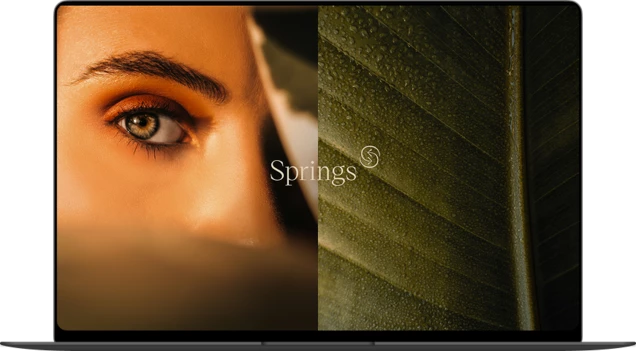
The Springs site is a meditative introduction to premium residences where balance and restoration are at the center of the story.
Only Work of Real Mastery Still Leaves an Impression
It isn't that AI is soulless and humans are. It's a question of bar. Emotion comes from a level of craft where meaning and form actually meet — where the execution has been worked out as fully as the idea itself. That level is rare on its own terms, no matter who — or what — is doing the work.
Which means the lack of emotional impact was never unique to AI. Most human-made sites miss it too, because mastery at the highest level doesn't scale and can't be automated. It can't be templated, can't be generated — every time, a custom real estate website is individual, hands-on work: dozens of small decisions converging into a feeling that refuses to be broken down into parameters. That very refusal is what puts the result out of reach for a generative model, which by nature reaches for the most probable, most average answer.
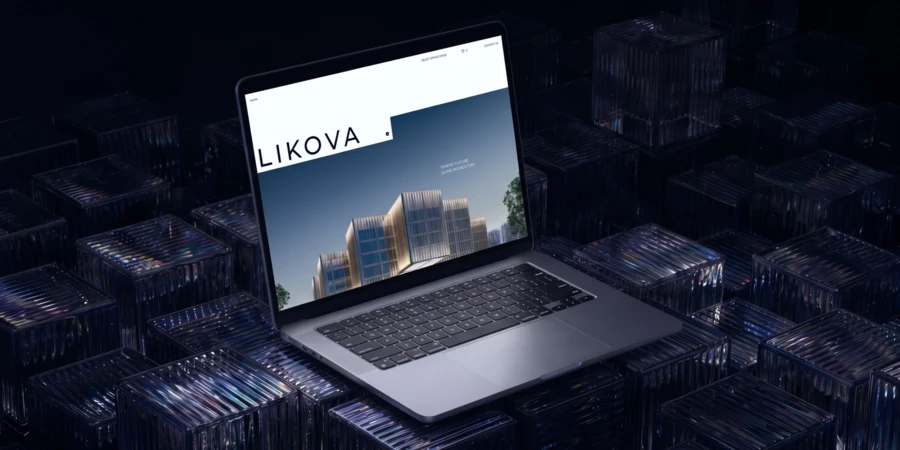
The AIR business center has futuristic architecture shaped by the movement of air. Its website picks up the same idea and gives every screen its own steady, breathing rhythm.
And the design has to hold the same bar as the product it represents: a premium property needs a site built with premium execution — otherwise you get a gap, a promise at one level and a delivery at another.
This Has Happened Before: How a Breakthrough Technology Elevated Luxury Design
In the 1970s, quartz watches turned out to be dozens of times more accurate than mechanical ones — and far cheaper to build. The Swiss watch industry, resting on centuries of mechanical craft, buckled under the shift: annual output dropped from over eighty million watches to thirty within a single decade, and two out of every three watchmakers lost their jobs.
The craft looked finished. What happened next was the opposite. Mechanical watches stopped being instruments and became objects of luxury — symbols of mastery and status, prized precisely for the intricate engineering hidden inside them. In 1972, Audemars Piguet released the steel Royal Oak at a price higher than watches made of gold, and in doing so, more or less invented the category of luxury watchmaking as we know it today — one where craftsmanship is the currency, not the weight of the metal. The industry didn't just survive; luxury exports quadrupled over the following two decades. Precision went to quartz. Value stayed with human hands.
Next-Generation 3D Tools: Letting People Touch the Product
None of this means luxury real estate web design is turning its back on new technology — quite the opposite. This is exactly where breakthrough tools tend to show up first, in commercial real estate website design as much as residential: competition is fierce, and each client is worth too much to cut corners on the impression a site leaves. One of the defining technologies here is interactive 3D.
What does a three-dimensional scene actually do? It reaches a different layer of perception. It's harder to build than a flat page, but easier for people to take in — a spatial scene reads as naturally to us as a real room does. It's denser with meaning, too: one glance at a 3D model conveys more than text or images could in the same stretch of time, all of it woven into the space itself rather than sorted into sections. And a scene like this invites interaction — turn the building, look around the neighborhood, walk the courtyard. That turns passive browsing into action, and action roots value more deeply than any description could — the richer and more memorable the experience, the more desirable the property becomes.
Technically, interactive 3D now runs on WebGPU — the standard that gives browsers direct access to the graphics processor. Its predecessor, WebGL, already brought 3D to the web, but WebGPU pushes performance close to native-app territory: heavy, interactive scenes that once needed a download now open from a link. Realism scales right alongside performance — materials, light, shadow, all of it reading as more convincing.
But the technology alone creates nothing. WebGPU is just the engine; the impression comes from the modeling, and that work is no lighter than the development itself. A building's geometry has to be built out, materials have to be told how to behave under light, a scene has to be lit so the wood reads warm and the stone reads cool. And then the fine-tuning starts on the web side: load speed, screen composition, user flow — all calibrated so a heavy scene opens in seconds and draws someone in instead of making them wait. That level of execution is rare, which is exactly why 3D done properly sets a project apart in a market where most competitors still lean on static renders.
The 3D Apartment Selector, Built on WebGPU
Unlike conventional selectors built on static renders or parametric tables, a WebGPU apartment selector turns choosing a unit into a fully interactive 3D environment. Visitors see exactly how the building sits within its surroundings, which way each apartment's windows face, which units open onto a view and which stare straight into the next building over. They can watch sunlight move across the façade through the seasons and hours of the day, then filter available units so the results light up right on the model. Instead of a table full of checkboxes, people get an interactive floor plan built into a volumetric model.
The Masterplan as a Navigable 3D Scene
A project's masterplan — building placement, landscaping, shared spaces — can be shown as a living model instead of a static diagram, with visitors moving through it on their own. They walk the grounds, step into the recreation areas, get a feel for how the buildings sit relative to one another, and grasp the project's scale and quality in a way a flat drawing never could. This matters even more for phased developments and mixed-use quarters, because a scene like this shows the finished picture long before it actually exists.
The Location Map, Rendered in WebGPU
Instead of a functional Google Maps embed, a map built specifically for the project — one where the location becomes tangible rather than abstract. The emphasis here is presentational, not navigational: selected points of interest nearby — schools, parks, the waterfront — shown in context, with animated routes and a visible sense of proximity. A map like this offers the most vivid, information-rich view of the surroundings.
On the Sea Breeze map, you can almost feel the sea air. Gulls circle over the water, cloud shadows slide across the beaches, and the surf plays quietly in the background.
Gaussian Splatting: A Real Place, Carried Into the Browser
Gaussian splatting delivers a photorealistic walk through an actual neighborhood, captured with an ordinary camera — no expensive LiDAR equipment required. From their own screen, visitors walk through real places: the park, the approach road, the surrounding streets, the green valley beside the building. This creates a high degree of immersion, which helps the information stick in memory far better.
AI on the Project Site: From Reference Desk to Conversation
If the mass-market web is handing over all of its function to AI, premium sites will start building AI in — just in a different role. AI devalues a site that only informs, because it does that job better. But the same AI, put to work in service of the experience, amplifies emotion instead of replacing it: it clears away the routine of searching and comparing, freeing up attention for the impression itself. Here, AI becomes a guide woven right into the site, walking a visitor through the project.
Conversational Infographics About Location
Instead of a "Location" section with a static map and pre-written copy, a visitor learns what actually matters to them through conversation. The answer arrives as a ready-made contextual block — a map with infographics, photo and video stories, interactive 3D elements. A young family asks about schools and gets a breakdown of nearby options with catchment areas and walking times. An investor asks about rental demand and sees an entirely different picture. The site answers questions no one could have anticipated in advance — and that produces a rare feeling: of being seen as an individual.
Context-Aware Prompts
The site reads behavior and steps in at just the right moment. Someone who's lingered on a particular floor plan gets similar available units, a virtual tour of that layout, or the purchase terms.
Rich-Media Storytelling, in Dialogue
The biggest shift is in the logic of the page itself: instead of fixed sections, AI assembles the right blocks and surfaces them directly within the page in response to a question. Floor plans, lifestyle imagery, pricing, availability — all of it surfaces in answer to what one specific person asked, shaping a scenario unique to them.
Generative Interior Visualization
Beyond a set of ready-made presets — the chance to see a unit rendered to your own taste. Within the limits set by the architecture and materials, a visitor changes what they'd otherwise have to imagine: light oak flooring swapped for dark walnut, the kitchen turned to face the window, a nook converted into a home office — and the room rebuilds itself on screen instantly. Browsing turns into active participation, and the attachment to a specific unit deepens: it stops being "an apartment" and becomes "my apartment."
AI Property Search, in Plain Language
Instead of filters and dropdown menus, a visitor just describes what they're looking for: "three bedrooms, park view, room for a home office, within this budget." AI parses the request, surfaces matching units, and explains why each one fits. Search stops being a query to a database and becomes a conversation with a consultant who actually understands what you want.
Memory Across Sessions
The platform remembers every visitor between visits — what they looked at, where they lingered, what they missed. Someone coming back is met with a personalized experience instead of a blank homepage, picking up right where they left off. Every return deepens the picture naturally, the way a conversation deepens the second time you have it.
What Remains, Once Everything Else Changes
The web is about to change more than most people expect. Most websites will dissolve into raw data, and the way people search for and absorb information will shift to AI agents. But premium real estate will swim against that current — and stand out all the more for it.
Because the decision to buy a home is never made where the facts are gathered. It's made where someone felt something. AI can bring a person to the threshold. What carries them across it is one deliberate choice that still strikes an emotional chord. That's the work Vide Infra considers its most important in real estate website design — building not just websites, but some of the best real estate websites in the business.
Get the edge with award-winning design and development for your real estate project!